Paving vs Concrete Driveways: Pros, Cons & Costs for Melbourne Homeowners
Choosing between paving and concrete for a new driveway is one of the most common decisions Melbourne and Bacchus Marsh homeowners face. Both work – but they perform differently across cost, longevity, and maintenance. The right choice depends on your budget, property style, and how well your site is prepared. This article breaks it down without the sales pitch.
Choosing between paving and concrete for a new driveway is one of the most common decisions Melbourne and Bacchus Marsh homeowners face. Both work – but they perform differently in cost, longevity, and maintenance, and the right choice depends on your budget, property style, and how your site is prepared. This article breaks it down without the sales pitch.
What’s the Difference Between Paving and Concrete Driveways?
Concrete driveways are poured as a continuous slab – plain, exposed aggregate, or stamped. Paved driveways use individual units (brick, bluestone, or concrete pavers) laid over a compacted base. Concrete is faster and cheaper to install; paving offers more design flexibility and easier repair but costs more upfront.
Concrete Driveways: Types, Costs, and Trade-offs
Concrete is the most widely installed residential driveway surface in Greater Melbourne. It’s structurally sound, low-maintenance, and cost-effective for large areas.
Plain Concrete
The baseline option. Smooth-finished, functional, and the cheapest concrete variant. Suits utilitarian applications where aesthetics are secondary.
- Cost: $50–$80 per m²
- Lifespan: 25–40 years with proper base preparation
- Maintenance: Minimal – occasional sealing recommended every 3–5 years
Exposed Aggregate Concrete
The most popular premium concrete finish in Melbourne. The surface aggregate is revealed during the pour, creating texture, slip resistance, and visual interest. We install more exposed aggregate driveways than any other type – it balances cost, aesthetics, and durability well for most residential properties.
- Cost: $60–$100 per m²
- Lifespan: 25–40 years
- Maintenance: Sealing every 3–5 years; minor surface repairs if aggregate loosens over time
Stamped (Decorative) Concrete
Concrete pressed with patterns mimicking pavers, slate, or timber. Delivers a high-end look at a mid-range price, though surface colour can fade over time and repairs are harder to match.
- Cost: $80–$120 per m²
- Lifespan: 20–35 years (surface finish degrades before the slab)
- Maintenance: Resealing every 2–3 years to maintain colour
Paved Driveways: Types, Costs, and Trade-offs
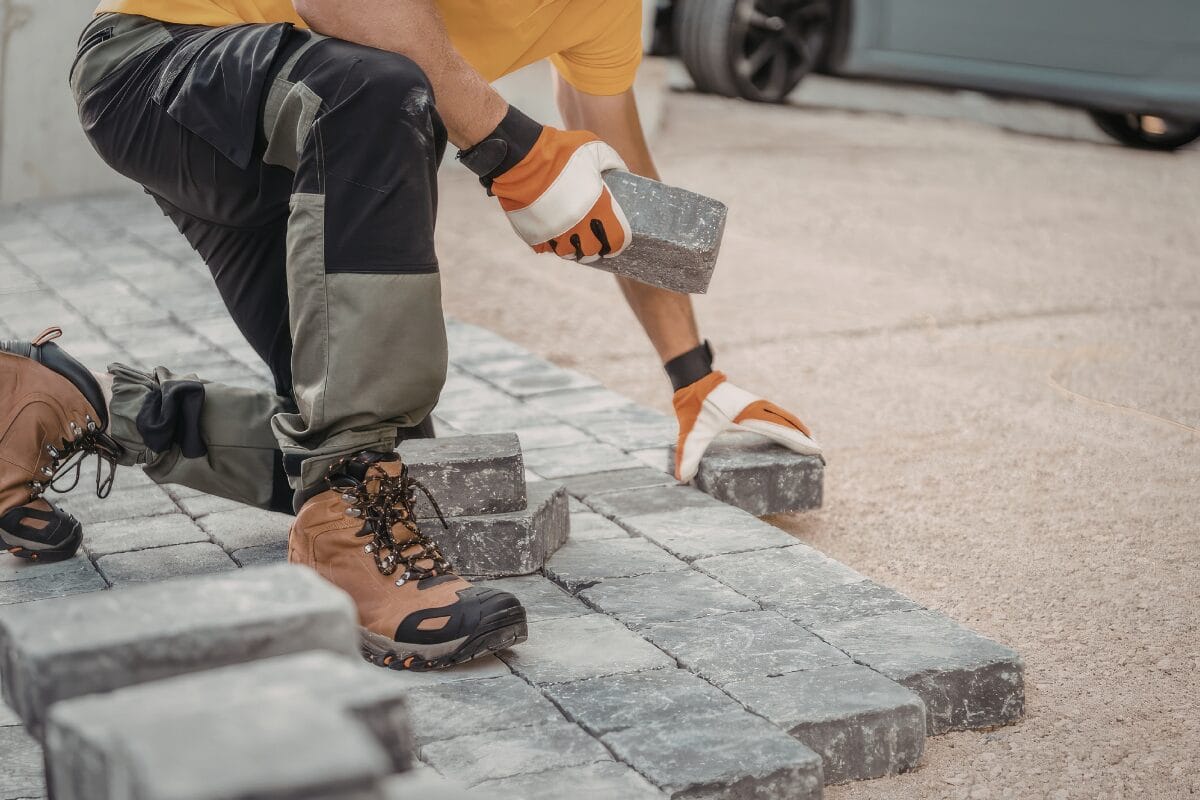
Paving uses individual units laid over a compacted aggregate base, with joints filled by sand or mortar. Individual pavers can be lifted and replaced – a significant maintenance advantage over concrete, where crack repairs are always visible.
Brick Pavers
A classic choice for heritage and character homes across Melbourne’s established suburbs and regional towns like Bacchus Marsh. Clay brick pavers age well and maintain colour better than concrete pavers.
- Cost: $80–$130 per m²
- Lifespan: 30–50+ years
- Maintenance: Weed control in joints; re-sanding periodically; individual pavers replaceable
Bluestone Pavers
The premium end of the paving market. Bluestone is a dense, durable basalt quarried primarily in Victoria – it’s slip-resistant, frost-resistant, and holds up exceptionally well in Melbourne’s climate. Expect to pay a premium for the material and skilled laying.
- Cost: $100–$180 per m²
- Lifespan: 50–100+ years
- Maintenance: Very low – occasional sealing; individual pieces replaceable
Concrete Pavers
The most cost-effective paving option. A wide range of colours, sizes, and finishes are available from manufacturers like Adbri Masonry and Boral. Quality varies significantly – premium concrete pavers outperform budget options in colour retention and surface hardness.
- Cost: $60–$120 per m²
- Lifespan: 20–40 years depending on product quality
- Maintenance: Weed control in joints; re-sanding; individual pavers replaceable
Cost Comparison: What Does a Full Driveway Actually Cost?
Material rate per m² only tells part of the story. The total installed cost includes site excavation, base preparation, and drainage – which adds $1,500–$5,000 to any driveway project depending on site conditions.
| Surface Type | Material + Install (per m²) | Typical 50m² Driveway (inc. base) |
|---|---|---|
| Plain Concrete | $50–$80 | $4,000–$7,000 |
| Exposed Aggregate | $60–$100 | $5,000–$8,500 |
| Stamped Concrete | $80–$120 | $5,500–$9,500 |
| Concrete Pavers | $60–$120 | $5,000–$9,500 |
| Brick Pavers | $80–$130 | $5,500–$10,000 |
| Bluestone | $100–$180 | $7,000–$13,500 |
Figures based on standard residential driveway in Greater Melbourne / Bacchus Marsh, 2026. Site-specific conditions may affect cost.
Durability in Melbourne’s Climate: What You Need to Know
Melbourne’s climate presents a specific challenge for driveways: the combination of hot, dry summers and cold, wet winters creates expansion-contraction cycles that stress any rigid surface. Moorabool experiences this more acutely than coastal suburbs – summer temperatures regularly exceed 40°C, and winter frosts are common.
Concrete slabs without adequate control joints are prone to cracking under these thermal stresses. Paved surfaces handle movement better because the joints between individual units accommodate expansion – but poorly bedded pavers will rock and shift if the base preparation isn’t right.
The base is the critical variable for both surfaces. A driveway built on a poorly compacted or inadequately drained base will fail regardless of what’s on top. This is why the excavation and base preparation stage is as important as the surface material itself.
Proprietary Insight: What We See on Bacchus Marsh Sites
Across driveway projects we’ve completed in Moorabool over the past three years, the most common failure we’re called in to assess is concrete cracking on slabs where control joints were undersized or omitted entirely – typically on DIY-finished or low-cost installs. The second most common issue is paved surfaces where individual pavers have settled unevenly due to inadequate base compaction. In both cases, the surface material was fine – the problem was the preparation underneath it.
On reactive clay sites (which make up the majority of residential blocks in Bacchus Marsh), we consistently specify a minimum 100mm compacted road base sub-layer before any surface goes down. On sites with drainage issues, that increases to 150mm with an integrated drainage layer. This adds cost, but it’s what separates a driveway that lasts 30 years from one that needs repair in five.
Aesthetics and Resale Value
Surface choice has a measurable impact on first impressions and buyer perception, though hard resale data specific to driveways is limited. Our general observation across Melbourne’s property market is that exposed aggregate concrete and quality brick paving add perceived value without the premium cost of bluestone, making them the most commercially rational choices for most homeowners.
Stamped concrete can look impressive when new but ages less gracefully than natural or aggregate surfaces – colour fade and surface wear become visible over time in a way that plain exposed aggregate doesn’t.
Which Lasts Longer in Melbourne’s Climate?
For longevity on a well-prepared base: bluestone and quality brick paving outlast concrete in the long run. For cost-per-year of service life, exposed aggregate concrete is hard to beat – it delivers 25–40 years with minimal intervention at a lower upfront cost than paving.
The honest answer: both will last decades if the base is right. Both will fail prematurely if it isn’t.
Installation Timelines
- Concrete driveways: 2–4 days for excavation and pour; 7 days curing before vehicle use; 28 days to full strength
- Paved driveways: 3–6 days for excavation, base, and laying; usable immediately after completion (no curing period)
Your Next Steps
- Set your budget range – use the cost table above to establish a realistic figure including base preparation
- Consider your home’s style – exposed aggregate suits most contemporary homes; brick suits heritage or character properties; bluestone for premium finishes
- Check your site conditions – slope, drainage, and existing materials all affect the scope and cost; a site visit is the only way to get an accurate number
- Get an itemised quote – ensure excavation, base preparation, and drainage are explicitly included, not assumed
Get a quote for your driveway →
Frequently Asked Questions
Is paving or concrete better for a driveway in Melbourne?
Both are suitable in Melbourne’s climate when properly installed. Concrete (particularly exposed aggregate) is more cost-effective for larger areas. Paving offers easier repair and greater design flexibility. The quality of base preparation matters more than the surface choice.
How long does a concrete driveway last in Victoria?
A well-installed concrete driveway on a properly compacted base typically lasts 25–40 years in Victoria’s climate. Adequate control jointing and sealing every 3–5 years extends service life significantly.
Do I need council approval for a new driveway in Moorabool?
A crossover permit from Moorabool Shire Council is generally required when connecting your driveway to the public road. This covers the kerb crossing point. The driveway itself on private property typically does not require a planning permit, though building permit requirements may apply in some circumstances. We confirm this at the quoting stage.
Can I drive on concrete straight away?
No. Concrete requires a minimum of 7 days before light vehicle use and 28 days to reach full structural strength. Driving on it earlier risks surface damage and premature cracking.
Bottom Line
There’s no universally superior choice between paving and concrete — both deliver excellent results when installed correctly. Exposed aggregate concrete is the most cost-effective option for most Bacchus Marsh homeowners and the one we recommend most often. Brick and bluestone paving are worth the premium where aesthetics and long-term repairability matter. Stamped concrete sits in the middle but requires more maintenance to stay looking its best.
What determines whether any driveway succeeds or fails isn’t the surface — it’s the base underneath it. Get the excavation, compaction, and drainage right, and your driveway will still be performing in 30 years. Cut corners on the groundwork, and no surface finish will save it.
If you’re ready to move forward or just want a realistic number to plan around, we’re happy to walk your site and give you an itemised quote with no obligation.
Get a quote for your driveway in Bacchus Marsh or greater Melbourne →